

Suture Practice Pad — 14 Pre-Cut Wounds in 8 Types, in 3-Layer Silicone
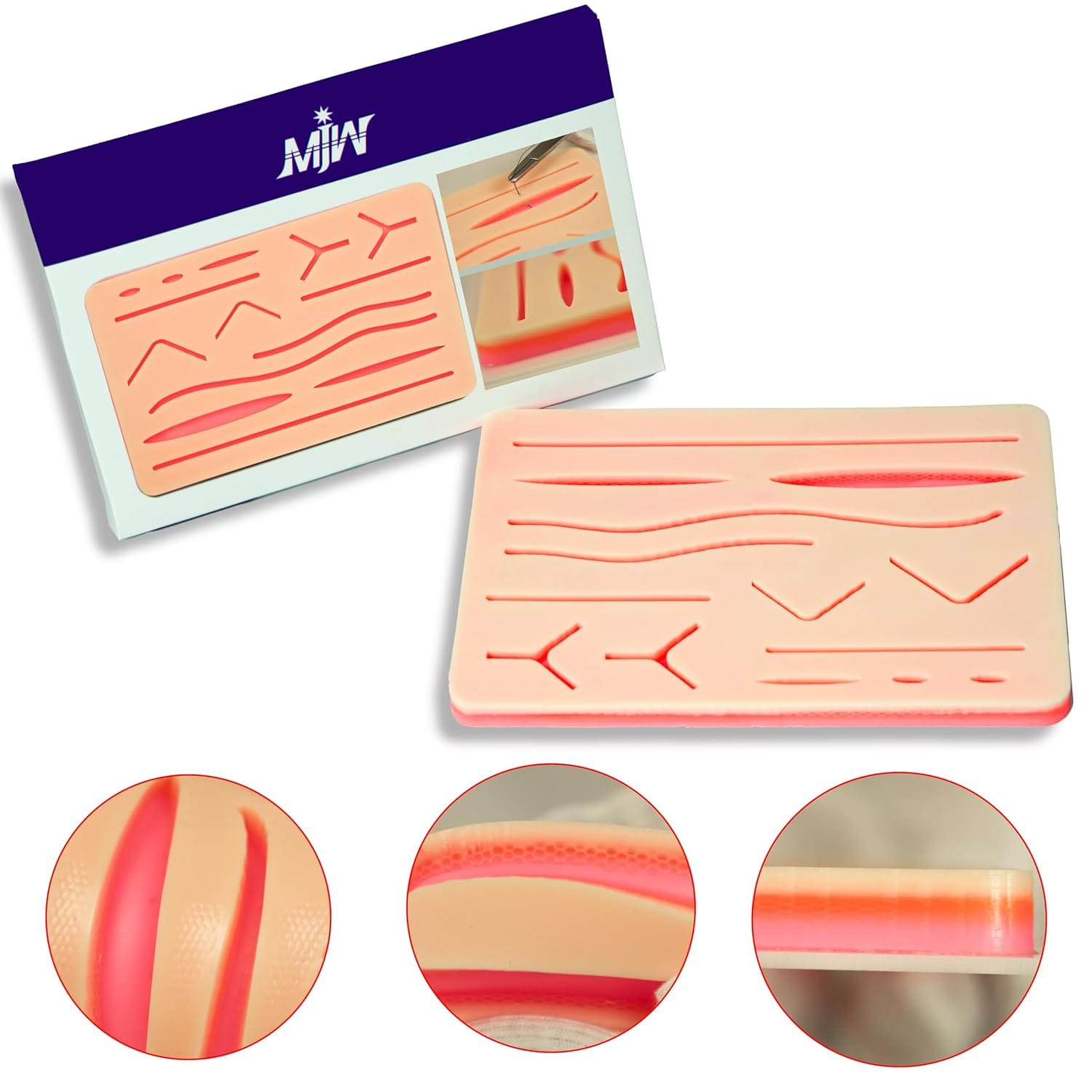
Our suture practice pad is a light pink, mesh-reinforced silicone pad with 14 pre-cut wounds across 8 wound types. It measures about 18 × 13 cm and is supplied as a pad only, without instruments or sutures. We ship from Sialkot, Pakistan, and a quote request carries no obligation.
14 pre-cut wounds in 8 types: straight, curved, Y-shaped, Z-shaped, irregular, circular or oval, cross-pattern and varied depth. Pad only, about 18 × 13 cm. Price, delivery and terms are confirmed in your quote.
Request a Free Quote Download PDF CatalogueOne pad, no instruments. Everything below is the pad itself, so you can compare it with the 20-wound and 27-wound pads.
What Makes a Good Suture Practice Pad for Students and Skills Labs?
A good suture practice pad gives realistic needle resistance, survives repeated passes and offers enough variety that you are not rehearsing the same closure every session. MJW Surgical's suture practice pad has 14 pre-cut wounds across 8 wound types, a 3-layer silicone build and embedded mesh. It is CE marked and made under an ISO 13485 quality system. Certificates are available on request.
The pad is light pink, so black silk thread, spacing and tension are easy to read. Each of the three layers stands in for a different tissue: epidermis, subcutaneous fat and muscle. That layering means the needle meets different resistance as it goes deeper, which is the feedback a flat foam block cannot give. Horizontal and vertical mesh runs through the silicone, which helps the pad hold together under knot tension.
7 Reasons to Choose This Suture Practice Pad
The 8 Wound Types on the 14-Wound Pad
Fourteen wounds would be less useful if they were all the same, so the pad spreads them over eight shapes. Straight linear incisions of different lengths are the foundation for interrupted and continuous suturing. Curved incisions imitate soft tissue lacerations and curved surgical cuts. Y-shaped wounds have three points that meet, so you learn to manage tension at a junction.
Z-shaped wounds are zigzags that need careful planning of the order in which you close them. Irregular lacerations are jagged and uneven, much like trauma wounds. Circular or oval openings suit purse-string and circumferential practice. Cross-pattern wounds have four points and make you decide the direction of each stitch. Varied depth wounds include shallow and deeper cuts, so you practise both superficial and full-thickness closure.
Suturing Techniques You Can Practise
Used with your own needle holder, forceps and thread, the pad supports simple interrupted sutures, continuous or running sutures, vertical and horizontal mattress sutures, figure-of-eight sutures and subcuticular closure. It is also a good surface for instrument-tied knots such as the surgeon's knot and square knot, and for hand-tied knots if your course teaches them. Repeat each technique until spacing, tension and knot security are even from one stitch to the next.
Because the pad is reusable for multiple sessions, you can time yourself and compare results week by week. How long a pad lasts depends on needle size and how heavily you work it. When a pad is worn, replace the pad alone and keep your instruments.
Suture Practice Pad or Complete Kit?
This is a pad only. It suits learners and teams who already own a needle holder, forceps, scissors, scalpel and sutures, and institutions that want extra pads to refresh stations. If you are starting from nothing, the complete suture training kit adds a Mayo-Hegar needle holder, iris scissors, two forceps, a scalpel handle with blades, sterile silk sutures and a zippered case. The kit uses the same family of pad, so the practice is the same.
You can see every option on our suture practice pads and kits page. Skills labs often buy kits for new learners and pads to replace worn ones, which keeps the cost per session low.
A 3-Week Plan With Your Suture Practice Pad
Week 1: instrument handling only. Load the needle, pass it through a straight wound and release it safely. Week 2: simple interrupted sutures with instrument-tied knots on the straight and curved wounds, aiming for even bites and neat trimming. Week 3: continuous and mattress sutures on the Y, Z and irregular wounds with a timer, then a full run-through from set-up to trimmed tails. Adjust the plan to your course and your instructor's guidance.
Using and Looking After the Pad
Practise on a flat, well-lit surface and keep the pad steady, for example on a non-slip mat. Use the smallest needle suited to the exercise, because heavier needles and aggressive technique shorten the life of any silicone pad. Rotate through the wounds rather than reusing the same one, and wipe the pad clean after each session. Always handle needles and blades safely, dispose of sharps as your institution requires and store everything out of reach of children and pets.
Who Uses a Suture Practice Pad Like This
Medical students prepare for practical assessments, and our medical students page and guide to practising suturing for OSCE explain how. Nursing students build wound closure confidence, as set out on the nursing students page. Dental students can start with this pad before moving to the dedicated dental pad. Skills labs, hospitals and clinics use identical pads for induction and refresher training. This pad is for practising technique and is not affiliated with or endorsed by any examining body.
Bulk Supply for Institutions
Universities, nursing colleges, hospitals, clinics and simulation labs can order the suture practice pad in bulk, and we can agree framework pricing for repeat orders. Every pad in an order is identical, which keeps teaching and assessment consistent. Hospital buyers can read about bulk suture kits for hospitals, and the same approach applies to standalone pads.
Ordering and Delivery
We ship worldwide from Sialkot, Pakistan. Price, delivery time, duties and taxes, shipping terms and payment options are confirmed in your quote, so send your quantity and we will reply with exact figures. A single pad or a large order can both be quoted through the form.
Which Pad Is Next?
If you need more variety, the 20-wound pad and the 27-wound pad add more wound shapes. For your own layouts, the plain customized pad and the dual pad let instructors cut their own wounds. For intraoral work, see the dental suture practice pad.